
Artificial intelligence has moved rapidly from experimental chat interfaces into the core operating fabric of modern enterprises. Across procurement, finance, software engineering, supply chain management, and customer operations, organizations are deploying large language models (LLMs), automated document evaluators, and machine-learning decision systems. Yet a wide capability gap remains: many students, working professionals, educators, and business leaders have used consumer AI tools casually, but far fewer understand the architecture, engineering workflows, and governance controls required to apply AI reliably in an enterprise environment.
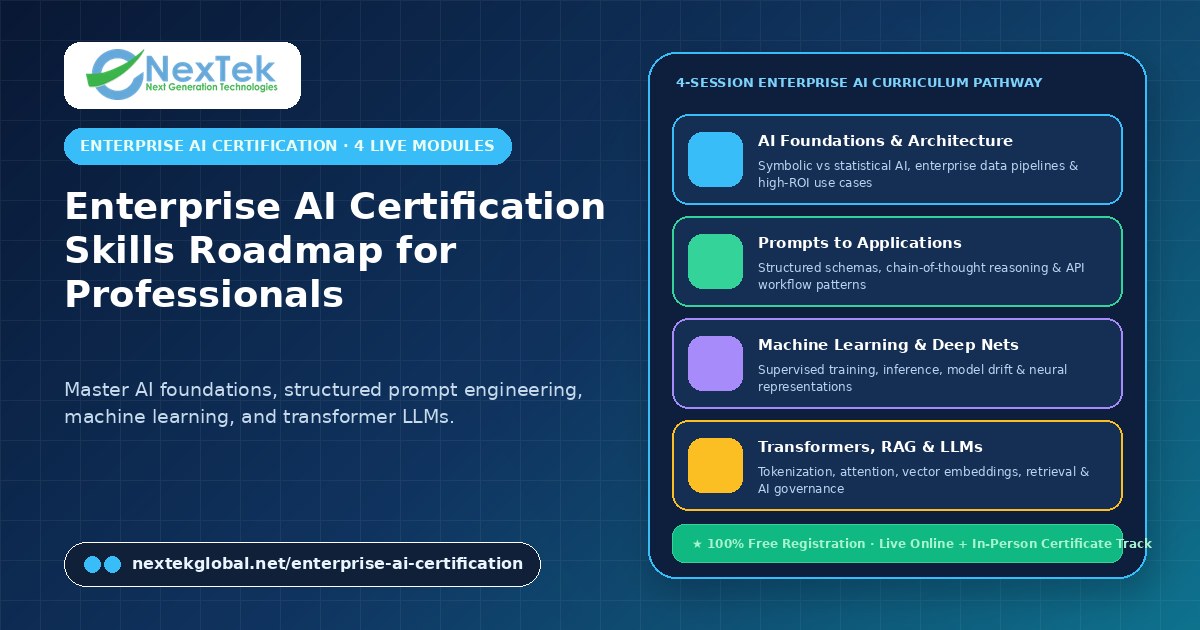
To bridge this gap, Nextek Global launched the Free Enterprise AI Certification Program—a structured, four-session live learning pathway designed to take ambitious learners from foundational AI concepts to practical mastery of prompt engineering, machine learning, transformer architectures, and enterprise LLM applications.
Why Practical Enterprise AI Fluency Matters in 2026 and Beyond
In the workplace, superficial familiarity with generative AI—such as typing ad-hoc one-line prompts into a public chatbot—rarely produces repeatable business results. Enterprise AI requires a connected understanding of how models process information, why hallucinations or biases occur, how retrieval and structured prompting ground outputs in verified business data, and how platforms like GPTCor and ePurchase govern security, compliance, and operational accuracy.
Whether you are a university student preparing for an AI-shaped job market, a working professional automating procurement or finance workflows, an educator guiding technical curricula, or a founder evaluating AI investments, structured training gives you three decisive advantages:
- Architectural clarity: Understand the real relationship between symbolic rules, classical machine learning, deep neural networks, transformers, embeddings, and large language models.
- Applied workflow capability: Move from isolated chat prompts to repeatable, structured prompting patterns, API workflows, and retrieval-augmented enterprise applications.
- Governance and risk awareness: Recognize sensitive-data exposure, prompt injection risks, shadow AI pitfalls, and the policy controls needed for responsible enterprise adoption.
Inside Nextek Global’s Four-Session Enterprise AI Certification Journey
Unlike fragmented video playlists or theoretical lectures that stay divorced from real business systems, the Nextek Global Enterprise AI Certification Program is organized as four connected, instructor-led live sessions. Each session builds directly on the previous module to form a cohesive technical and operational narrative.
Session 01: AI Foundations — From Core Concepts to Enterprise Context
The program opens by demystifying the vocabulary and system architecture of modern artificial intelligence. Participants explore how intelligent systems evolved from deterministic software rules to statistical learning and generative foundation models. Key topics include:
- Distinguishing narrow AI, predictive analytics, computer vision, natural language processing (NLP), and generative AI.
- How enterprise data pipelines, training corpora, and compute infrastructure shape model capability and cost.
- Mapping high-ROI business use cases—such as automated supplier specification extraction in ePurchase and governed knowledge assistants in GPTCor—while avoiding common hype traps.
Session 02: Prompts to Applications — Structured Prompt Engineering & Workflows
In the second session, participants transition from passive users to deliberate workflow designers. Prompt engineering in an enterprise context is not about “magic phrases”; it is about specifying clear context, constraints, schemas, and evaluation criteria so language models produce deterministic, auditable outputs. Topics covered include:
- System instructions, role framing, few-shot exemplars, and structured output schemas (such as JSON tables and compliance matrices).
- Chain-of-thought decomposition, self-consistency verification, and grounding model responses strictly in supplied source documents.
- Designing multi-step application workflows that connect prompt templates with validation logic, human-in-the-loop review, and enterprise APIs.
Session 03: Machine Learning — Data, Training, Inference, and Real Decisions
To use AI responsibly, professionals must understand how models actually learn from data and where statistical inference can fail. Session 03 provides an accessible yet rigorous walkthrough of the machine-learning lifecycle without requiring an advanced mathematics degree:
- Supervised, unsupervised, and reinforcement learning explained through concrete business decisions (demand forecasting, anomaly detection, credit risk, and supplier scoring).
- Feature engineering, training versus validation splits, overfitting, underfitting, and model drift in production environments.
- Deep learning fundamentals: how multi-layer neural networks, weights, activation functions, and gradient descent learn complex representations across text, tabular records, and images.
Session 04: Transformers & LLMs — Tokens, Embeddings, Retrieval, and the Modern Ecosystem
The final session dives into the transformer architecture that powers today’s leading large language models and multimodal systems. Participants gain a practical mental model of how enterprise LLM applications are architected and secured:
- Tokenization, context windows, self-attention mechanisms, and how transformers capture long-range semantic relationships.
- Vector embeddings, semantic search, and Retrieval-Augmented Generation (RAG) for connecting LLMs to private enterprise knowledge bases without retraining models.
- Enterprise AI security and governance: preventing sensitive data exfiltration, governing model access, and maintaining audit trails using Enterprise AI Governance practices.
| Program Module | Core Technical Focus | Practical Enterprise Takeaway |
|---|---|---|
| 01 · AI Foundations | AI taxonomy, system architecture, and business problem framing | Evaluate where AI adds measurable operational value vs. deterministic automation |
| 02 · Prompts to Applications | Structured prompting, output schemas, and validation workflows | Design reliable, repeatable AI workflows for document analysis and operations |
| 03 · Machine Learning | Training pipelines, inference, deep learning, and evaluation metrics | Understand model accuracy, bias, drift, and data quality requirements |
| 04 · Transformers & LLMs | Tokens, attention, embeddings, RAG, and enterprise AI governance | Architect and govern secure LLM applications across business teams |
Who Should Apply for the Enterprise AI Certification Program?
Nextek Global designed this program to be inclusive of motivated beginners while offering substantive depth for experienced practitioners:
- Students & recent graduates: Build verifiable AI literacy, technical vocabulary, and practical project context that stand out in interviews across software, analytics, and business operations roles.
- Working professionals: Connect generative AI and machine learning directly to daily responsibilities in procurement, finance, engineering, IT support, HR, and project management.
- Educators & trainers: Gain a structured, industry-grounded framework for teaching modern AI concepts and practical enterprise applications.
- Founders & business leaders: Ask sharper architectural, commercial, and security questions when selecting AI vendors, commissioning custom software, or rolling out internal AI policies.
Flexible Hybrid Attendance: Live Online or In-Person Options
Because learners join from across Pakistan, the United States, and international locations, the Enterprise AI Certification Program offers flexible attendance preferences. Registrants can opt for Live Online cohort sessions—participating interactively with Nextek instructors and peers from anywhere—or express interest in In Person / Onsite sessions in their city, or select Interested in both. Registration is 100% free with no application or tuition fee.
How to Register and Prepare for Your Cohort
Applying takes less than two minutes on the Enterprise AI Certification registration page. Complete all mandatory profile fields—including your full name, work or study email, phone number, company or institution, designation/job title, city, current AI experience level, attendance preference, and learning goal—so the Nextek Global team can assign you to the appropriate cohort and share schedule and certificate-completion details directly.
Frequently Asked Questions
Is there any fee to join the Nextek Global Enterprise AI Certification Program?
No. The four-session Enterprise AI Certification Program is 100% free to join, with no registration or tuition fee.
Do I need prior coding or advanced math experience to attend?
No prior machine-learning or programming background is required. Whether you are just getting started, already exploring AI tools, or actively building with AI, the four sessions progress logically from foundations to advanced LLM architectures.
How do I apply for the next cohort?
Visit the Enterprise AI Certification page and submit the mandatory registration form to reserve your place.

 AI-enabled procurement platform
 FBR digital invoicing integration
 Enterprise AI governance platform