
Across every industry, employees are already using generative AI to draft client proposals, summarize financial reports, debug application code, and analyze operational data. When organizations fail to provide a secure, governed enterprise AI workspace, ambitious teams do not stop using artificial intelligence—they simply turn to unmanaged personal accounts, browser extensions, and public consumer AI tools. This phenomenon, known as Shadow AI, has rapidly become one of the most urgent data-protection and compliance challenges facing Chief Information Security Officers (CISOs), CIOs, and legal leaders.
Blocking generative AI outright is neither realistic nor competitive: blanket bans frustrate employees, drive usage further underground onto personal mobile devices, and deprive the business of genuine productivity gains. The practical solution is governed enablement. Nextek Global built GPTCor—our Secure Enterprise AI Governance Platform—paired with our Enterprise AI Governance consulting services, to give organizations a centrally managed access layer with sensitive-prompt Data Loss Prevention (DLP), role-based model policies, and complete audit visibility.
Understanding the Real Security Risks of Unmanaged Generative AI
When an employee pastes a block of text or uploads a spreadsheet into an unapproved public AI service, that data leaves the organization’s security perimeter immediately. Depending on the consumer tool’s terms of service, submitted prompts and files may be retained on external servers, reviewed by third-party contractors, or used to train future public model weights.
In enterprise security assessments conducted by Nextek Global, unmanaged AI usage consistently creates exposure across four sensitive data categories:
- Proprietary source code and engineering architecture: Developers pasting internal API keys, database schemas, proprietary algorithms, or security vulnerability traces into public coding assistants.
- Confidential financial and commercial records: Finance and procurement analysts uploading unreleased earnings figures, M&A models, supplier pricing matrices, or board presentations for summarization.
- Regulated personal and customer data (PII / PHI): Customer support, HR, or healthcare staff pasting client names, national ID numbers, account histories, or medical records to draft correspondence.
- Legal strategy and contract terms: Operations teams submitting draft litigation memos, NDA-protected partner agreements, or regulatory correspondence to external LLMs without legal oversight.
The Six Core Pillars of the GPTCor Enterprise AI Governance Platform
To make generative AI productive across the business without losing security, visibility, or control, GPTCor sits between your workforce and approved language models as an intelligent governance and security layer:
- 01 · Secure AI Gateway: Route all approved enterprise AI traffic through a single, centrally governed workspace authenticated with your corporate identity provider.
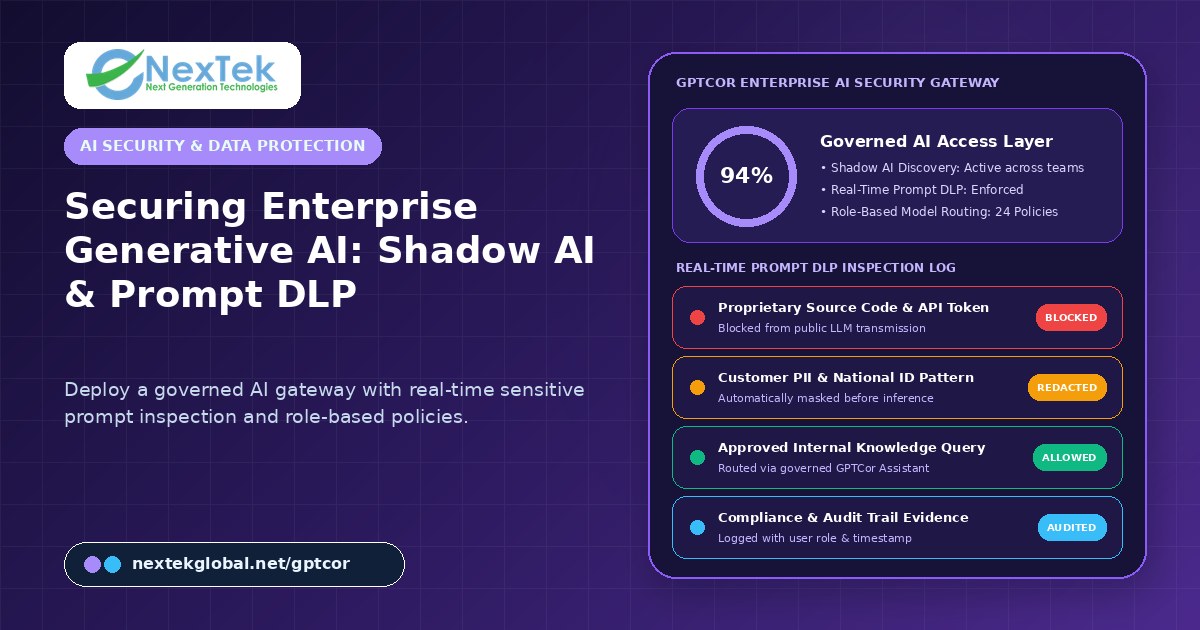
- 02 · Sensitive Prompt Protection (AI DLP): Inspect prompts and attachments in real time to detect, redact, or block confidential, personal, financial, or proprietary information before it ever leaves your environment.
- 03 · Role-Based AI Policies: Apply granular model, feature, and data permissions by department, user role, office location, and risk profile.
- 04 · Shadow AI Visibility: Identify where unapproved AI tools and unmanaged usage patterns create business, security, or regulatory exposure.
- 05 · Audit & Compliance Reporting: Maintain tamper-evident, searchable activity logs and policy enforcement evidence for security, internal audit, and executive review.
- 06 · Controlled Business AI Assistants: Deploy domain-specific assistants for internal knowledge, customer service, operations, sales, finance, and IT support under strict data-access boundaries.
How Real-Time Sensitive Prompt Protection (AI DLP) Works
Traditional network firewalls and legacy endpoint DLP tools were designed to monitor file transfers or email attachments, not conversational AI prompts where sensitive context is interwoven with natural language instructions. A single prompt might combine a legitimate request (“Summarize the key renewal risks in this vendor contract”) with highly confidential data (the vendor’s bank account details, pricing tiers, and named executive contacts).
GPTCor’s Sensitive Prompt Protection engine inspects every outgoing prompt in real time before forwarding the request to an external or hosted LLM. Using a combination of pattern recognition, contextual entity detection, and organization-specific policy rules, GPTCor evaluates the prompt against your security classifications:
- Block with educational feedback: If an employee attempts to paste source code containing credentials, customer PII, or restricted financial tables, GPTCor blocks the transmission immediately and explains which policy rule was triggered so the user learns safe prompting habits.
- Mask or anonymize sensitive entities: Where appropriate, sensitive identifiers (such as client names, phone numbers, or account IDs) can be sanitized prior to model inference so the employee still receives analytical assistance without exposing raw personal data.
- Route to approved private models: High-sensitivity internal workflows can be automatically restricted to approved private or enterprise-tenanted models that guarantee zero data retention and zero training on customer inputs.
| Governance Dimension | Unmanaged Consumer AI (Shadow AI) | GPTCor Enterprise AI Governance Platform |
|---|---|---|
| Access & Identity | Personal emails and shared credentials with no central revocation | Enterprise SSO, role-based access control, and centralized user management |
| Sensitive Data Protection | PII, source code, and financial data sent directly to public servers | Real-time prompt inspection blocking or masking confidential data prior to transmission |
| Model & Feature Control | Users select arbitrary public models with unknown data-retention terms | Granular policies governing which teams can access specific approved models |
| Audit & Compliance Trail | Zero visibility for security, legal, or compliance teams | Searchable prompt and policy logs supporting NIST AI RMF, ISO, and internal audits |
| Business Knowledge Use | Manual copy-pasting of internal documents into public chat windows | Governed Business AI Assistants connected to approved internal knowledge sources |
Designing Role-Based AI Policies Across Departments
Effective AI governance recognizes that different teams have very different risk profiles and operational needs. An overly rigid, one-size-fits-all policy either stifles innovation or leaves gaps in high-risk functions. Through GPTCor and Nextek Global’s Enterprise AI Governance consulting, organizations establish tiered policy matrices:
- Software Engineering & IT: Enable code-generation and architecture assistants while enforcing strict blocks on secrets, API tokens, production connection strings, and proprietary repository dumps.
- Finance, Procurement & Legal: Permit contract summarization, vendor specification analysis (alongside specialized platforms like ePurchase), and policy drafting while protecting unreleased financial results and personally identifiable banking records.
- Sales, Marketing & Customer Support: Provide pre-configured Business AI Assistants grounded in approved product documentation, pricing sheets, and support playbooks so customer-facing responses remain accurate and on-brand.
A Four-Step Implementation Roadmap for Enterprise AI Governance
Organizations working with Nextek Global across the United States and Pakistan typically operationalize AI governance in four structured stages:
- Discover AI Usage & Assess Risk: Inventory current generative AI use cases, identify shadow AI exposure, and classify high-risk data assets.
- Define Acceptable-Use Policy & Operating Model: Establish clear, practical guidelines for employees alongside governance ownership across IT, security, legal, and business units.
- Enable Approved Access via GPTCor: Deploy the secure AI gateway, configure sensitive-prompt DLP rules, and roll out role-based model permissions.
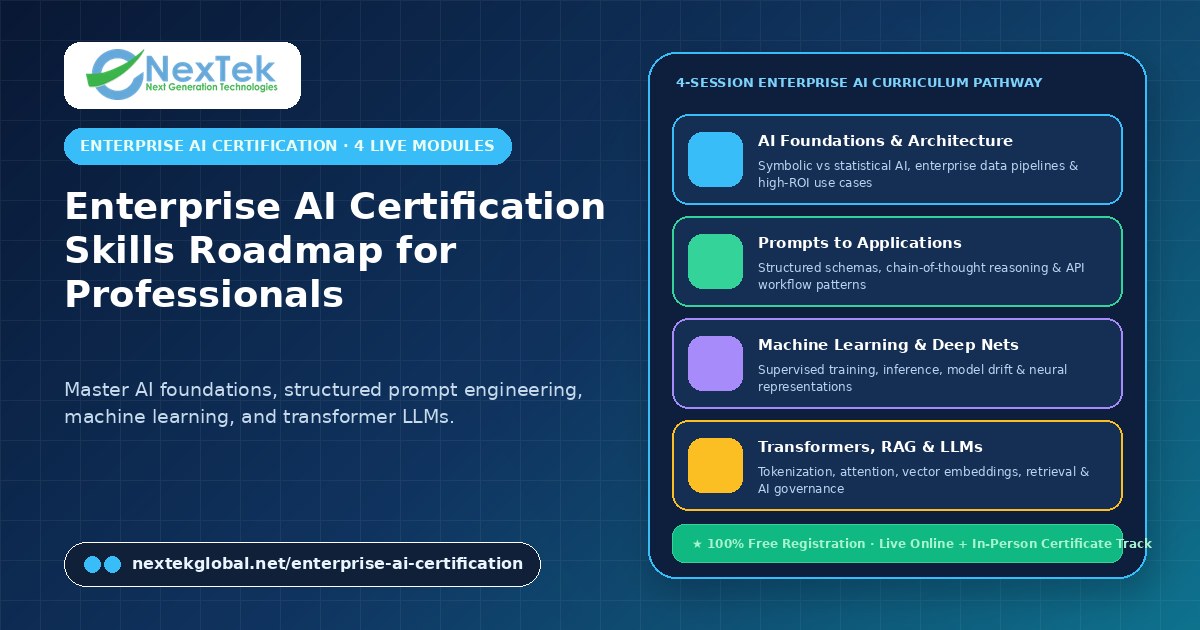
- Measure, Audit & Upskill Teams: Review usage analytics and compliance reports while training employees through programs such as Nextek Global’s Enterprise AI Certification Program.
Frequently Asked Questions
Does GPTCor require us to build our own large language model from scratch?
No. GPTCor provides a secure governance, policy, and prompt-protection layer that connects your workforce to leading approved AI models and internal business assistants without the cost of training a foundation model from scratch.
How does GPTCor help with regulatory and customer security audits?
GPTCor maintains searchable activity records, blocked-prompt logs, and role-based policy evidence so security and compliance teams can demonstrate concrete AI risk controls to auditors and enterprise clients.
How can we evaluate GPTCor for our organization?
Visit the GPTCor platform page or schedule an Enterprise AI Governance consultation with Nextek Global.


 AI-enabled procurement platform
 FBR digital invoicing integration
 Enterprise AI governance platform