
Enterprise procurement teams face a persistent bottleneck between issuing a Request for Quotation (RFQ) and awarding a Purchase Order (PO): technical bid evaluation (TBE). While commercial price comparisons can be tabulated relatively quickly once line items are aligned, technical evaluation requires procurement engineers, category managers, and quality reviewers to read dozens of multi-page vendor proposals, datasheets, certificates of analysis, and custom exception schedules. When five or six suppliers respond to a complex industrial, pharmaceutical, or IT tender using completely different document formats, units of measurement, and terminology, manual comparison in spreadsheets becomes slow, inconsistent, and vulnerable to human oversight.
Nextek Global built the ePurchase AI-Enabled Procurement Platform and its flagship ePurchase AI-Powered Technical Evaluator to eliminate this exact bottleneck. By combining automated document intelligence with structured procurement governance, ePurchase transforms unstructured supplier submissions into normalized specifications, proactive vendor risk audits, side-by-side technical compliance matrices, and instant, audit-ready compliance scores.
Why Manual Technical Bid Evaluation Slows Enterprise Purchasing
In regulated and capital-intensive industries—such as pharmaceutical manufacturing, chemical processing, consumer packaged goods, energy, and multi-plant industrial operations—purchasing decisions cannot be made on unit price alone. A lower-priced quotation that quietly omits a required material grade, offers an inferior warranty window, or introduces a non-standard tolerance range can cause production downtime or regulatory non-compliance costing many times the initial savings.
Traditionally, procurement teams manage technical evaluations by copying requirements from a Purchase Requisition (PR) or scope of work into a master spreadsheet and manually keying in each vendor’s response line by line. Across dozens of technical parameters, this manual workflow introduces four structural problems:
- Inconsistent supplier terminology and units: One supplier quotes pressure ratings in bar while another uses PSI; one lists packaging dimensions in millimeters while another references standard pallet configurations; one attaches a 40-page PDF catalog rather than filling out the buyer’s template.
- Buried deviations and silent omissions: Vendors frequently mark a tender summary sheet as “Compliant” while embedding critical technical exceptions, alternative materials, or conditional performance caveats inside footnotes or annexures.
- Disconnected commercial and technical reviews: Engineering teams often review technical datasheets in isolation via email while buyers negotiate commercial terms separately, leading to version mismatches and delayed approval sign-offs.
- Fragile audit trails: When internal or external auditors review a high-value procurement award months later, reconstructing why one supplier was deemed technically qualified over a lower bidder requires digging through scattered email threads and unversioned spreadsheets.
Introducing the ePurchase AI-Powered Technical Evaluator
As the core highlight of the ePurchase AI-Enabled Procurement Platform, the ePurchase AI-Powered Technical Evaluator embeds domain-tuned artificial intelligence directly into the sourcing and quotation evaluation workflow. Instead of treating supplier PDFs, spreadsheets, and technical annexures as static attachments, ePurchase actively parses, normalizes, and evaluates every submission against your approved requisition and RFQ criteria.
The ePurchase AI-Powered Technical Evaluator delivers five integrated capabilities that work together from the moment supplier quotations are received:
- ✅ Automatically extracts & normalizes supplier specifications: Parses vendor proposals, technical datasheets, and schedules to align parameters, units, and tolerances against your baseline RFQ requirements.
- ✅ Audits custom vendor T&Cs for hidden risks & SLA gaps: Reviews supplier terms and conditions to surface service-level agreement omissions, support limitations, and delivery caveats before approval.
- ✅ Risk Audit — Automatically flags legal risks, non-standard payment terms, and warranty gaps: Highlights commercial and legal deviations such as advance-payment demands, capped liability clauses, or shortened warranty coverage.
- ✅ Delivers instant side-by-side compliance matrices: Constructs a structured, line-by-line technical compliance matrix comparing every bidder against each mandatory and preferred specification.
- ✅ Generates instant, audit-ready compliance scores: Calculates transparent, weighted compliance scores backed by traceable citations to the underlying supplier documents.
Step 1: Automated Extraction and Normalization of Supplier Specifications
The foundation of objective technical bid evaluation is specification normalization. When buyers issue an RFQ through ePurchase, the platform captures the structured technical baseline—including item descriptions, target specifications, acceptable tolerance bands, mandatory certifications (such as ISO, GMP, or FDA compliance), and delivery milestones. When suppliers upload their quotations and technical packets via the ePurchase Supplier Web Portal or Supplier Mobile App, the AI-Powered Technical Evaluator immediately extracts the relevant technical attributes from each submission.
Rather than performing simple keyword matching, the evaluator normalizes equivalent technical expressions into a unified comparison schema. For example, if a pharmaceutical packaging RFQ specifies moisture-barrier film thickness, tensile strength, and USP compliance, the evaluator maps each vendor’s stated laboratory values directly to the corresponding buyer requirement, flags unit conversions, and explicitly identifies any parameter where a supplier provided an ambiguous response or left the specification blank. Buyers and technical reviewers no longer waste hours retyping PDF tables into spreadsheets; they start their review with a clean, normalized dataset.
Step 2: Auditing Custom Vendor T&Cs, Legal Risks, and SLA Gaps
Even when a supplier’s product meets physical or engineering specifications, serious operational exposure often hides in the commercial and legal fine print attached to the bid. Suppliers routinely append their own standard sales conditions, service-level agreements (SLAs), or rider clauses that conflict with the buyer’s standard RFQ and PO terms.
The ePurchase AI-Powered Technical Evaluator performs an automated Vendor T&C and Procurement Risk Audit across every submitted offer. It compares vendor attachments against your organization’s baseline commercial and legal rules, automatically flagging exceptions across three critical dimensions:
- SLA and service coverage gaps: Identifies missing uptime commitments, slow incident response windows, excluded preventive maintenance visits, or ambiguous spare-parts availability.
- Non-standard payment and commercial terms: Flags deviations from standard net payment cycles (for example, demands for 100% advance payment, unapproved price-escalation formulas, or letter-of-credit modifications).
- Warranty and legal exposure: Detects shortened warranty durations, exclusions for normal operational wear, unilateral termination rights, or governing-law and indemnity clauses that shift undue risk to the buyer.
By surfacing these exceptions alongside the technical evaluation, ePurchase ensures that procurement officers, plant managers, and legal reviewers address contract risks before an award recommendation is routed for executive approval.
Step 3: Instant Side-by-Side Compliance Matrices and Audit-Ready Scoring
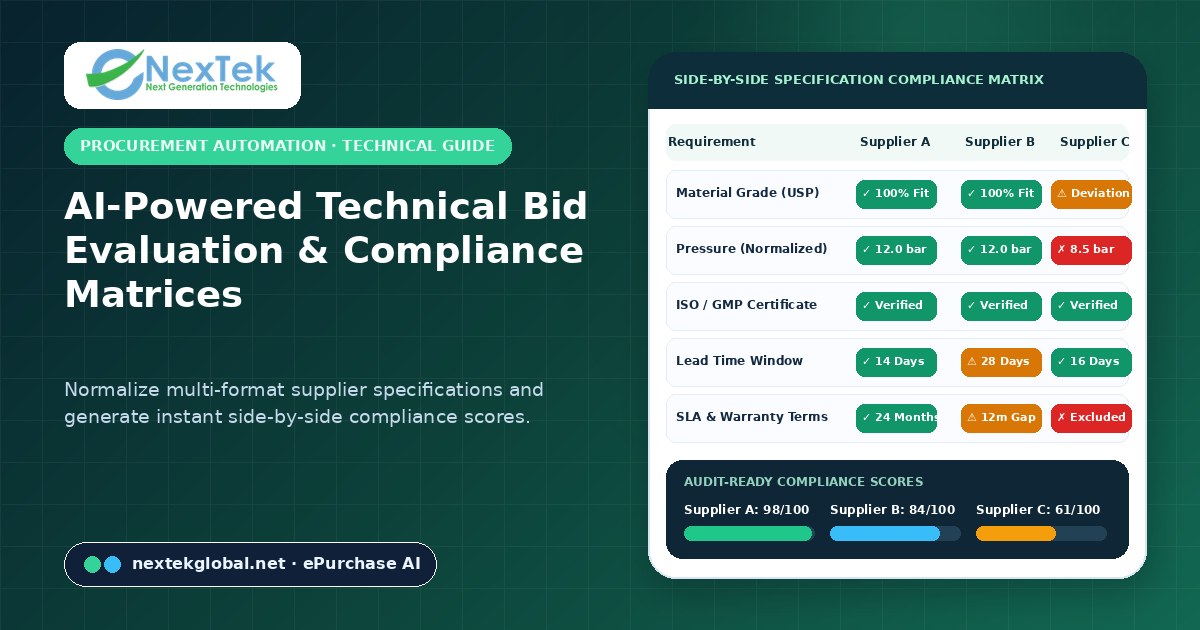
Once supplier specifications are normalized and contract exceptions are audited, the ePurchase AI-Powered Technical Evaluator generates an interactive, side-by-side technical compliance matrix. Every row represents a specific technical, operational, or contractual requirement from the RFQ, and every column represents a participating supplier.
Each cell in the compliance matrix displays the supplier’s normalized value, a clear compliance status indicator (Fully Compliant, Partially Compliant / Deviation, Non-Compliant, or Missing Information), and the exact exception note if a gap exists. Crucially, the platform rolls these item-level assessments up into instant, audit-ready compliance scores. Organizations can weight mandatory technical criteria, quality certifications, delivery lead times, SLA commitments, and warranty coverage so that the resulting score reflects real operational priorities rather than subjective impressions.
| Evaluation Dimension | Manual Spreadsheet & Email TBE | ePurchase AI-Powered Technical Evaluator |
|---|---|---|
| Specification Extraction | Manual copy-paste from multi-page vendor PDFs and catalogs | Automated AI extraction and unit normalization across all bids |
| Vendor T&C & SLA Review | Often overlooked until late-stage PO or legal review | Automated audit flagging hidden SLA gaps and service exclusions |
| Legal, Payment & Warranty Audit | Ad-hoc manual reading of fine print and annexures | Instant risk flags for non-standard payment terms and warranty gaps |
| Compliance Matrix Creation | Days of manual formatting and version reconciliation | Instant side-by-side compliance matrix generated on quote receipt |
| Scoring & Audit Evidence | Subjective notes scattered across email threads | Weighted, audit-ready compliance scores attached to the digital PR-to-PO trail |
Connecting AI Technical Evaluation to End-to-End PR-to-PO Workflows
A technical evaluation tool delivers maximum value only when it is natively connected to the rest of the procurement lifecycle. In ePurchase, the AI-Powered Technical Evaluator is not a disconnected utility—it operates inside a unified cloud workflow spanning Purchase Requisitions (PRs), RFQ automation, reverse auctions (eBID), multi-level rate comparison (RC) approvals, automated Purchase Order generation, and bidirectional ERP integration with SAP, Oracle, Microsoft Dynamics, and custom enterprise systems.
As demonstrated in Nextek Global’s published customer transformations—including Hamdard Laboratories (which connected ePurchase with SAP ERP to achieve a 100% digital procurement audit trail across 600+ products) and Helix Pharma (which cut procurement cycle time by 50% using AI-assisted vendor evaluation)—combining structured workflow automation with AI evaluation allows procurement teams to move faster while strengthening governance.
Implementation Checklist for Procurement Leaders
To capture immediate ROI from AI-enabled technical bid evaluation, procurement leaders should follow four practical steps during rollout:
- Standardize category requirement templates: Define baseline technical parameters, mandatory quality certificates, and standard payment/warranty rules for your top spend categories inside ePurchase.
- Onboard suppliers to digital quote submission: Use the ePurchase Supplier Web Portal and Mobile App so vendor quotes and technical datasheets flow directly into the evaluation workspace.
- Configure weighted scoring and risk thresholds: Align engineering, quality, finance, and procurement stakeholders on how technical compliance, SLA coverage, and commercial terms are weighted.
- Link evaluation approvals to ERP PO creation: Ensure that once a side-by-side compliance matrix and rate comparison are approved, the resulting Purchase Order and full audit history synchronize automatically with your core ERP.
Frequently Asked Questions
How does the ePurchase AI-Powered Technical Evaluator handle different supplier document formats?
The evaluator extracts and normalizes specifications across structured portal entries, uploaded schedules, and vendor proposals, aligning equivalent technical attributes into a single side-by-side compliance matrix so buyers can compare offers objectively.
Does AI technical evaluation replace human procurement and engineering sign-off?
No. The ePurchase AI-Powered Technical Evaluator accelerates analysis and eliminates manual data alignment by generating normalized matrices, risk flags, and compliance scores, while keeping final approval authority firmly with your designated engineering, procurement, and finance reviewers.
How can our organization test the ePurchase AI-Enabled Procurement Platform?
Eligible organizations can request a 30-day free trial of ePurchase or schedule a guided demonstration with Nextek Global’s teams in Karachi, Pakistan or Norcross, Georgia.



 AI-enabled procurement platform
 FBR digital invoicing integration
 Enterprise AI governance platform