
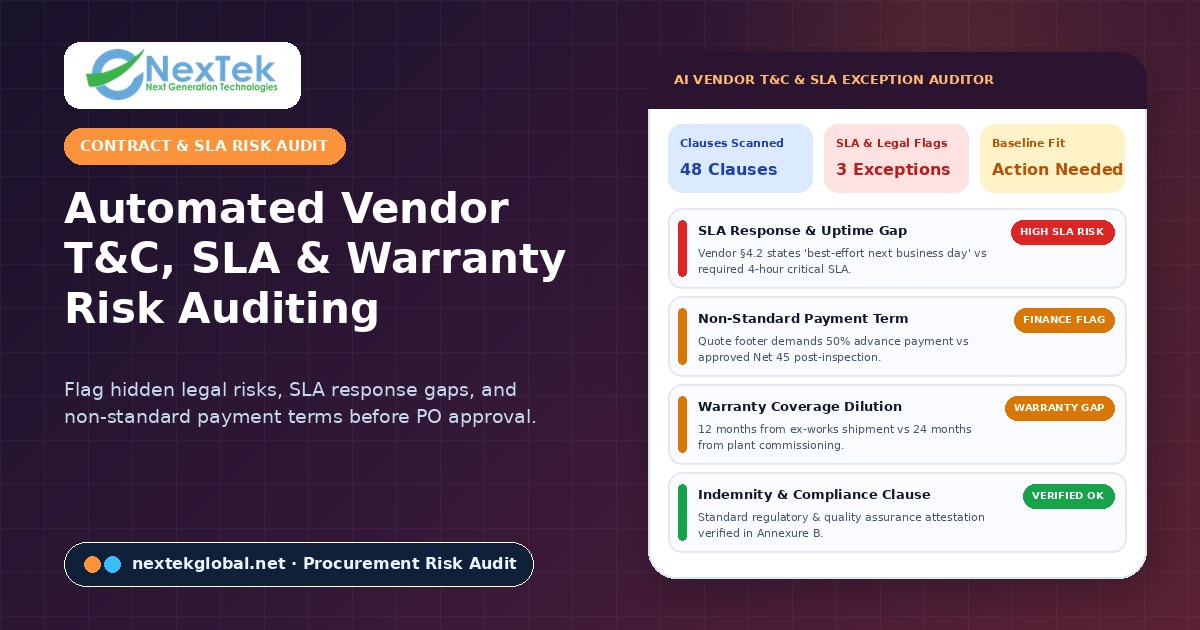
In enterprise procurement, the most expensive surprises rarely appear on the price line of a supplier quotation. Instead, they surface months after a Purchase Order (PO) is issued—when a critical piece of plant equipment fails and the vendor points to a 90-day warranty limitation buried in their quotation footer, when a software or maintenance provider misses a restoration window because their custom Service-Level Agreement (SLA) excluded weekend response, or when finance discovers that a supplier’s attached terms demand advance payment and impose unilateral price-index adjustments.
For procurement leaders managing hundreds of RFQs per month, manually reading every clause of every supplier’s custom Terms and Conditions (T&Cs) is practically impossible. Legal departments are typically engaged only for high-value master service agreements, leaving routine and mid-market purchase orders exposed to “battle of the forms” risks. Nextek Global solved this challenge by embedding automated Vendor T&C and Procurement Risk Auditing directly inside the ePurchase AI-Enabled Procurement Platform through the new ePurchase AI-Powered Technical Evaluator.
The “Battle of the Forms” Problem in Operational Purchasing
When an enterprise issues an RFQ, it includes its own standard purchasing terms—covering payment net days, delivery INCOTERMS, quality inspection rights, warranty durations, indemnification, and SLA expectations. However, when suppliers submit their quotations, they almost always attach their own standard commercial proposals, sales conditions, or technical riders. Inside those attachments, suppliers routinely insert language stating that their proposal is conditioned upon the buyer’s acceptance of the vendor’s terms.
When buyers focus exclusively on unit rates and delivery dates in a conventional rate comparison sheet, critical contractual deviations slip through unnoticed:
- Hidden SLA exclusions: A vendor quotes an attractive annual maintenance fee but defines response time as “next business day acknowledgment” rather than guaranteed on-site resolution, leaving production lines vulnerable to extended downtime.
- Non-standard payment terms: While the buyer’s RFQ stipulates Net 45 or Net 60 days after goods receipt and inspection, the supplier’s proposal embeds a requirement for 50% advance payment upon PO issuance and 50% prior to dispatch.
- Warranty dilution: The RFQ requires a 24-month comprehensive parts-and-labor warranty from commissioning, but the vendor’s fine print limits coverage to 12 months from factory shipment and excludes wearable assemblies.
- Legal and liability shifts: Custom vendor riders cap liquidated damages at a token percentage, disclaim consequential damages, or omit mandatory regulatory compliance warranties required in pharmaceutical, food, or export manufacturing.
How the ePurchase AI-Powered Technical Evaluator Audits Vendor Risk
The ePurchase AI-Enabled Procurement Platform transforms contract and risk review from a manual post-award bottleneck into an automated, real-time step during quotation evaluation. As part of its core five-pillar architecture, the ePurchase AI-Powered Technical Evaluator delivers:
- ✅ Automatically extracts & normalizes supplier specifications across diverse quotation formats and technical schedules.
- ✅ Audits custom vendor T&Cs for hidden risks & SLA gaps by comparing supplier attachments against your approved procurement baseline.
- ✅ Risk Audit: Automatically flags legal risks, non-standard payment terms, and warranty gaps so buyers and approvers see every exception clearly before sign-off.
- ✅ Delivers instant side-by-side compliance matrices that combine technical fit with commercial and contractual compliance.
- ✅ Generates instant, audit-ready compliance scores to support objective, defensible supplier selection.
Deep Dive 1: Auditing Custom Vendor T&Cs for Hidden Risks and SLA Gaps
Service-level agreements and operational support commitments are notoriously difficult to compare across multiple bidders because each vendor structures its service tiers differently. One vendor may include 24×7 remote diagnostics, four-hour critical response, and quarterly calibration in its base price, while a competing bidder quotes a headline price that is 12% lower but charges separately for emergency callouts, spare parts, and software patches.
When quotations are uploaded into ePurchase, the AI-Powered Technical Evaluator scans the supplier’s custom T&Cs, service schedules, and scope exclusions. It extracts the exact commitments for response time, resolution time, preventive maintenance frequency, escalation paths, penalty credits, and spare-parts coverage. Any gap between the buyer’s required SLA baseline and the vendor’s submitted terms is highlighted as an explicit SLA risk flag inside the evaluation workspace. Procurement teams can immediately quantify whether a lower-priced bid is genuinely more economical or merely shifting operational risk onto the buyer’s maintenance budget.
Deep Dive 2: Flagging Legal Risks, Non-Standard Payment Terms, and Warranty Gaps
Beyond service levels, the ePurchase Risk Audit engine systematically inspects every quotation for commercial and legal exceptions that impact working capital, asset reliability, and regulatory compliance:
1. Non-Standard Payment Terms and Commercial Conditions
Working capital discipline depends on predictable payment terms and clear milestone verification. The evaluator automatically flags supplier clauses that demand unapproved advance payments, shorten net payment windows, introduce foreign-exchange fluctuation surcharges, impose minimum order penalties, or trigger automatic annual price increases without buyer consent.
2. Warranty Coverage and Quality Assurance Gaps
In manufacturing and engineering procurement, warranty start dates and scope definitions matter as much as the headline warranty length. A 12-month warranty starting at ex-works shipment may expire only six months after equipment is installed and commissioned at a plant in Karachi or Atlanta. The ePurchase Risk Audit compares the vendor’s stated warranty trigger, duration, parts/labor inclusion, and replacement turnaround time against the RFQ baseline, flagging any dilution immediately.
3. Legal, Regulatory, and Compliance Clauses
For organizations operating under strict quality and regulatory frameworks—such as pharmaceutical cGMP, FBR tax compliance, or enterprise data protection—supplier contracts must preserve audit rights, intellectual property protections, confidentiality, and statutory compliance. The evaluator flags unilateral liability caps, missing indemnification, unapproved subcontracting clauses, and omitted compliance attestations so legal or senior procurement reviewers can intervene early.
| Risk Category | Typical Hidden Exception in Vendor Quote | ePurchase AI Risk Audit Action |
|---|---|---|
| SLA & Support Gaps | “Best-effort” response instead of 4-hour guaranteed resolution; excluded site travel | Flags SLA gap in side-by-side compliance matrix and adjusts compliance score |
| Payment Terms | 50% advance with order; balance before dispatch instead of Net 45 post-inspection | Highlights working-capital deviation for finance and procurement approvers |
| Warranty Coverage | 12 months from shipment instead of 24 months from commissioning; consumables excluded | Flags warranty duration and trigger mismatch prior to RFQ award |
| Legal & Liability | Vendor T&Cs override buyer PO terms; liability capped at 5% of order value | Surfaces high-priority legal exception requiring buyer counter-clause or clarification |
| Delivery & Penalties | Estimated lead times labeled non-binding; liquidated damages clause struck out | Marks delivery commitment as conditional and records exception in audit trail |
Embedding Risk Audits into Multi-Level Procurement Approvals
Detecting contract and SLA exceptions is only effective if those findings are visible to the decision-makers who approve the spend. In traditional organizations, a buyer might notice a payment-term deviation during negotiation, agree to it informally over email, and route a simplified rate comparison sheet to management that shows only unit prices. Approvers sign off without realizing they have accepted non-standard commercial or warranty exposure.
In ePurchase, the AI-Powered Technical Evaluator’s risk audit findings, side-by-side compliance matrices, and audit-ready compliance scores remain permanently attached to the digital Rate Comparison (RC) and Purchase Order approval workflow. When department heads, finance controllers, or executive committee members review an award recommendation, they see:
- The complete commercial rate comparison across all invited suppliers.
- The side-by-side technical compliance matrix showing exact specification alignment.
- All flagged vendor T&C, SLA, payment-term, legal, and warranty exceptions, together with how those exceptions were resolved or approved.
- The weighted, audit-ready compliance score for each bidder.
Strengthening Procurement Governance Across USA and Pakistan Operations
Whether your organization is modernizing procurement across multi-plant manufacturing operations or scaling corporate purchasing governance, combining procurement transformation consulting with the ePurchase AI-Enabled Procurement Platform creates a repeatable, transparent control environment. Every custom RFQ term, supplier acknowledgement, risk flag, clarification message, and approval timestamp is preserved in a searchable electronic history.
Frequently Asked Questions
Can ePurchase enforce our organization’s custom RFQ and PO Terms & Conditions?
Yes. All ePurchase plans—Standard, Pro, and Enterprise—support customizable RFQ Terms & Conditions, custom PO Terms & Conditions, and supplier document submission and acknowledgement, while the AI-Powered Technical Evaluator audits vendor counter-proposals for deviations.
How does automated vendor risk auditing reduce procurement cycle time?
By automatically surfacing SLA gaps, non-standard payment terms, and warranty exceptions as soon as quotations are submitted, buyers can request targeted supplier clarifications immediately rather than discovering legal blockers days later during final PO sign-off.
Where can we see ePurchase in action?
Explore the ePurchase product page to compare Standard, Pro, and Enterprise plans, or request a 30-day trial with Nextek Global.



 AI-enabled procurement platform
 FBR digital invoicing integration
 Enterprise AI governance platform