
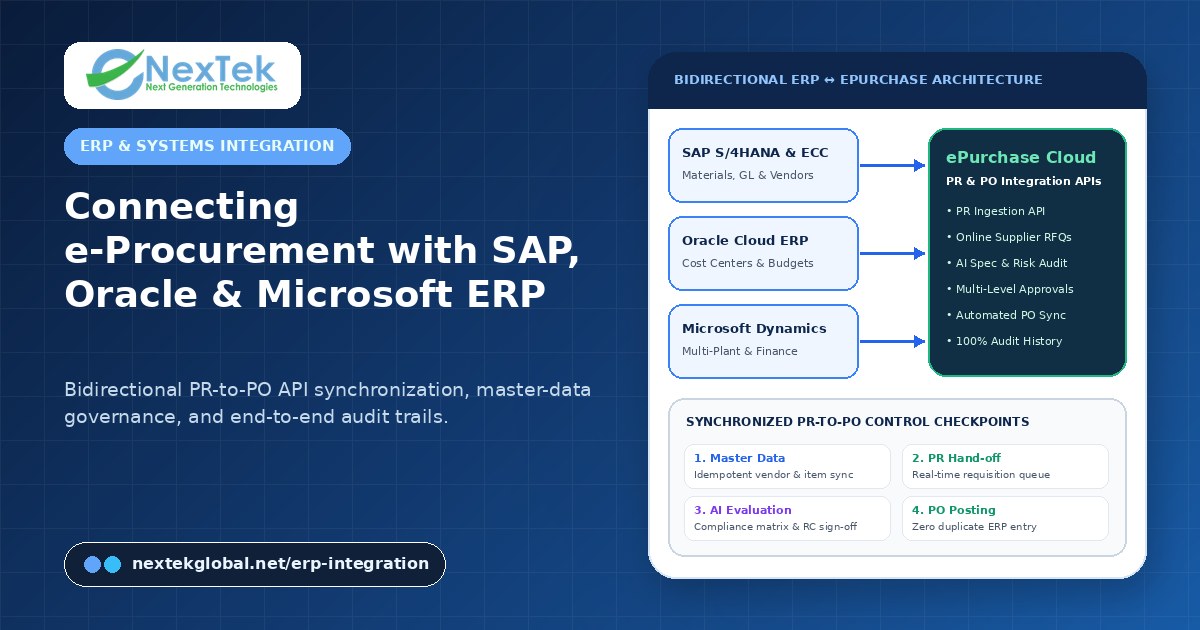
Core Enterprise Resource Planning (ERP) platforms—such as SAP S/4HANA, SAP ECC, Oracle Fusion Cloud ERP, Oracle E-Business Suite, and Microsoft Dynamics 365—excel at general ledger accounting, inventory valuation, production planning, and financial consolidation. However, most traditional ERPs were never designed to provide an agile, supplier-friendly experience for collaborative sourcing, online Request for Quotation (RFQ) portals, mobile vendor bidding, reverse auctions, or AI-powered technical bid evaluation. As a result, procurement teams using a standalone ERP often fall back on email, paper files, and spreadsheets for everything that happens between an initial Purchase Requisition (PR) and a final Purchase Order (PO).
Conversely, deploying a cloud procurement platform as an isolated silo creates its own problems: buyers have to re-key approved purchase orders back into the ERP, vendor master records drift out of alignment, and finance loses real-time visibility into committed spend. Nextek Global resolves this tension by combining the ePurchase AI-Enabled Procurement Platform and eInvoicing with structured ERP & Business Systems Integration Services.
Core Architectural Principle: Defining System-of-Record Ownership
The most important decision in any ERP-to-procurement integration is establishing unambiguous system-of-record (SoR) ownership for every data entity and transaction stage. When two systems are allowed to modify the same record simultaneously without clear ownership rules, reconciliation errors are inevitable.
In Nextek Global’s proven integration architecture—deployed across complex manufacturing enterprises including Hamdard Laboratories—system ownership is partitioned cleanly across the purchasing and financial lifecycle:
- Master Data Ownership (ERP as Primary, Synchronized to ePurchase): Material master codes, units of measure, plant/warehouse locations, cost centers, GL accounts, tax codes, and approved vendor master identifiers are governed centrally and synchronized so procurement and finance always reference the exact same codes.
- Sourcing & Evaluation Ownership (ePurchase as Primary): Once a purchase demand is initiated, ePurchase owns RFQ creation, parallel supplier distribution, online/mobile vendor quotation collection, the ePurchase AI-Powered Technical Evaluator (specification normalization, vendor T&C risk audits, side-by-side compliance matrices, and compliance scoring), reverse auctions, and multi-level rate comparison approvals.
- Execution, Receipt & Financial Settlement (Synchronized PR-to-PO-to-Invoice): Approved sourcing awards generate Purchase Orders that synchronize bidirectionally with the ERP for goods receipt (GRN), three-way matching, payable posting, and downstream FBR digital invoicing where applicable.
End-to-End Data Flow Across the Integrated PR-to-PO Lifecycle
Through ePurchase’s built-in Purchase Request Integration API and Purchase Order Integration API (available on Pro and Enterprise plans), data moves across four controlled integration checkpoints without manual re-entry:
Checkpoint 1: Purchase Requisition (PR) Ingestion
Demand can originate either inside the core ERP (for example, triggered by MRP inventory reorder points or maintenance work orders in SAP) or directly inside ePurchase for indirect and capital spend. When a PR is approved in the ERP, the Purchase Request Integration API transmits the line items, quantities, required delivery dates, plant codes, and technical specifications into ePurchase automatically, assigning the requisition to the responsible buyer queue.
Checkpoint 2: Supplier Onboarding, RFQ Distribution, and AI Evaluation
Within ePurchase, buyers group PR lines into RFQs and invite approved suppliers from the centralized vendor database. Suppliers submit commercial quotes and technical datasheets via the web portal or mobile app. Immediately upon submission, the ePurchase AI-Powered Technical Evaluator extracts and normalizes supplier specifications, audits custom vendor T&Cs for SLA gaps, flags legal, payment-term, and warranty risks, and builds an instant side-by-side compliance matrix with audit-ready scores.
Checkpoint 3: Multi-Level Rate Comparison (RC) and PO Approval
Once technical and commercial evaluations are complete, ePurchase routes the combined Rate Comparison and AI compliance matrix through configurable, role-based approval hierarchies. Approvers review the full decision package—historical pricing, budget context, AI risk flags, and supplier compliance scores—and record their digital sign-off with a permanent timestamp.
Checkpoint 4: Automated Purchase Order Synchronization to ERP
Upon final approval, ePurchase generates the Purchase Order and invokes the Purchase Order Integration API to post or update the corresponding PO inside SAP, Oracle, or Microsoft Dynamics. The ERP receives the awarded vendor code, negotiated unit prices, currency, tax codes, payment terms, delivery schedule, and the unique ePurchase reference ID linking back to the complete sourcing audit trail.
| Workflow Stage | Primary Activity | Integration Pattern & Control Mechanism |
|---|---|---|
| 01 · Master Data Sync | Items, plants, cost centers, currencies, and vendor master records | Scheduled or event-driven API sync with schema validation and duplicate prevention |
| 02 · PR Hand-off | Approved ERP purchase requisitions routed to sourcing workspace | ePurchase Purchase Request Integration API with idempotent reference tracking |
| 03 · AI Technical & Bid Review | RFQ collection, spec normalization, T&C risk audit, and RC approval | Executed natively in ePurchase with full digital audit trail retention |
| 04 · PO Synchronization | Approved award converted to ERP Purchase Order for GRN and AP | ePurchase Purchase Order Integration API with automated acknowledgement and retry queue |
| 05 · Digital Invoicing | Outbound sales invoices and returns mapped to regulatory APIs | Nextek eInvoicing SAP / ERP mapping and FBR sandbox/production validation |
Engineering for Resilience, Security, and Multi-Plant Scale
Enterprise integrations fail when they assume networks and upstream databases are always available and that every payload is perfectly formatted. In Nextek Global’s ERP & Systems Integration engagements, every interface is engineered around four production safeguards:
- Idempotency and duplicate protection: Every PR and PO payload carries a deterministic transaction key so network retries never create duplicate purchase orders in SAP or Oracle.
- Pre-flight schema and master-data validation: Before a PO is pushed to the ERP, the integration layer verifies that the vendor code is active, the plant and storage location match, and currency/exchange rates are valid.
- Durable queueing and exception monitoring: If the ERP is undergoing scheduled maintenance, transactions remain safely queued with automated retry backoff and administrator alerts.
- Role-based and object-level security: Combined with ePurchase’s two-factor authentication, IP access control, location-aware security, and user change logs, API credentials operate under least-privilege scopes.
Real-World Impact: Hamdard Laboratories Case Study
The business value of connecting ePurchase with a tier-one ERP is illustrated clearly in Nextek Global’s Hamdard Laboratories case study. Operating since 1948 with more than 600 herbal and pharmaceutical products, Hamdard previously relied on paper files and spreadsheets that required duplicate data entry into SAP ERP. By implementing ePurchase with bidirectional SAP synchronization, Hamdard eliminated manual re-entry, centralized its supplier database across departments, accelerated multi-level approvals, and established a 100% searchable digital procurement audit trail.
Frequently Asked Questions
Which ERP platforms can integrate with Nextek ePurchase and eInvoicing?
Nextek Global supports integrations with SAP (ECC and S/4HANA), Oracle, Microsoft Dynamics, and custom enterprise systems via REST APIs, structured data connectors, and client-side integration services.
Can we deploy ePurchase across multiple manufacturing plants and currencies?
Yes. The ePurchase Pro plan supports up to three plants and multi-currency quote/PO management, while the Enterprise plan supports unlimited plants, unlimited users, dedicated test and production environments, and up to six years of audit-ready data retention.
How do we plan an ERP and procurement integration assessment?
Explore our ERP & Systems Integration Services or contact Nextek Global to schedule an architecture discovery session with our Karachi or Norcross teams.
How does the ePurchase AI-Powered Technical Evaluator work alongside ERP integrations?
When a Purchase Requisition is synchronized from SAP, Oracle, or Microsoft Dynamics into ePurchase, the AI-Powered Technical Evaluator uses the requisition’s technical specifications and your standard commercial terms to evaluate incoming vendor quotations automatically—normalizing supplier specs, auditing custom vendor T&Cs for hidden SLA and legal risks, and producing instant side-by-side compliance matrices and audit-ready scores before pushing the approved Purchase Order back to the ERP.



 AI-enabled procurement platform
 FBR digital invoicing integration
 Enterprise AI governance platform